Monday, April 20, 2009

Interview Thank You Letters by Stephen Wickens


After you have an interview with a prospective employer, it’s always important to write them a thank you letter, or email. This is a must, because employers think less of those interviewees who fail to follow-up promptly after their interview. Make sure to send these letters out as soon as possible, after finishing with your interview. Usually within 24hours after the interview was completed.


When you are required to write something it is always nice to personalize it. Customizing your letters to keep your audiences issues and concerns at hand is very important to do. It allows you to reach out to your reader, connecting with them on certain levels. Usually letter are hand typed, as this is the most professional way to do things, but some managers seem to like hand written letters as well because it adds personality to your writing.


When thinking of what to write within your letter, make sure you thank the person to whom you are talking to, but also remember to let them know you want the job, and that you are serious about what you do. Vise-versa if you do not want the job, write a thank you letter respectfully withdrawing your application, because you never know what the future hold so why burn your bridges.


After you are finished with your letter make sure you proofread carefully, checking your spelling along with your grammar. If in doubt about the correct names, spellings or titles of your interviewers, call the office to double-check. Your efforts will be worth it!


Technical Documents in Web-Based Format by Robert Hunley

Writing technical documents in web based format can be a pain but to improve your writing and impact on the web, remember this:

Be Consistent. Keeping the document consistent and organized creates a basic trust that the reader gains. Keep Templates, Margins, Fonts pretty much the same though out your entire project.

By doing this you keep things simple to the reader, soon they learn to understand your style,

Writing a Business Invitation Letter by Sally Vale

A business invitation letter serves two purposes:
  • invites clients/coworkers to an event or
  • Ensures that the client/coworker will be attending the event.

Keep tense in mind when differentiating between the two purposes:

  • Present tense is used while inviting the attendee
  • Future tense is used when ensuring the attendee will come to the event.

It is important to keep a professional tone throughout the letter.


In the introduction, give a brief background of your organization, and what the event tends to accomplish.
In the body of the letter, include the outline of how the event will go, the date and time of the event, and the date by which the receiver should R.S.V.P.
In the closing sentences of the letter, you should tie the letter together with a quick statement, and thank the reader for their time and in advance for responding.

Here is a video overviewing the basics of writing an effective and professional business letter:

I found these tips and more at:

Lavie, Yaron. "Business Invitation Letter: Quick Guide and Effective Tips". SelfGrowth. April 20 2009 .

Thursday, April 16, 2009

Fight Fair By Chelsie Kistner


Conflict in the workplace? It’s inevitable to happen, especially in work groups. When there are more than a couple of people coming together with different values, personalities, and even perspective of the goal of the group, it is almost impossible to not have butting of heads. Thankfully, there is a solution or at least ways of easing the pain and coming to resolution where everyone wins. Some of these tips are simple as the rules we learned back in Kindergarten. Maybe now it’s time to refresh our memory and apply them to group works.
1. Be respectful. Do to others, as you would have them do unto you. Seems simple but it will go a long way. No need to bad mouth and name call.
2. Take a breather. Instead of allowing your emotions to rule the situation, try to stay calm and talk things out in an adult manner. The more emotionally intense the situation gets, the further you are from resolution.
3. Speak up. So often, people retreat in time of conflict. You may have something good to add to the conversation that will bring another viewpoint and possibly bring compromise to the group. Do not be afraid to be heard, as long as it’s in an indirect, respectful tone.
4. Stop with the blame game. No matter how or by whom you got to the problem at hand, work together to find a solution. The more you’re pointing fingers, the more defensive and standoffish other team members will be.
5. Be open to other ideas. As much as you may think your way is the only way, be willing to hear others out and possibly change your mind. You may be surprised to discover others have something great to bring to the table.
References:
Image: Cartoonstock.com, aton182

Analyzing Your Audience by Ervin Garibovic


Before you start writing any kind of document or speech, the first thing you must think about is who is my audience and what am I trying get across. This is going to help you get started on your paper and it will keep you focused throughout the writing process. The first step in analyzing your audience is to classify each reader or listener based on his or her knowledge of the subject. In every case, you should approach the audience as if they have no knowledge on content, even if they are educated on it. Below are some tips to use when analyzing your audience.

1. What is the age? Age is very important in analyzing your audience because it is different when you are speaking to teenagers than adults. You must take the age into account before you begin your assignment.
2. Gender , are you speaking to men or women or both. Depending on the topic each gender can have their own opinions toward certain views. Analyzing the gender is very important.
3. How will the information your present help your audience.
4. How knowledgeable is your audience on the topic.
5. What are some facts that they need to know or want to know in order to understand you proposal.


Monday, April 13, 2009

Who's Write??

\Toon\


This is just an example of how not proofreading and being clear in your message, could leave others confused. It is crucial to make sure you are using the right words in the right places. Don't always rely on spell check.

The other thought comes from a play on words. Most people think it's silly that we, as professionals, need help in wiring. You may assume that you have all your writing skills down to a science and have no room for improvement. You may be doing yourself a disservice by thinking you are always right, like this man in the cartoon. Be open to new education. Learn from those around you. Let your writing skills be taken to the next level.

Proofreading and Editing Tips by Sally Vale


Proofreading and Editing Tips by Sally Vale


With all the advantages of Microsoft Word, it is easy to forget that the spelling and grammar check doesn’t always fix every error you make. So as much of a pain as it might seem, it’s important to physically proof read and edit your own work. Even then, though, it can be easy to miss an error you may have made. Here are some interesting tips to help you find and fix those mistakes!


  • Print out the document. I know, I know, it’s wasteful, but I find that it’s a lot easier to see mistakes I’ve made if I’m holding something tangible in my hands.

  • Proofread specifically: do one check for spelling errors, one check for punctuation, one for grammar, etc.

  • Know your flaws. I, for example, tend to use a passive voice all the time when I’m writing. So I make sure to look specifically for when I do this.

  • Read words backwards. It sounds time consuming, but it really helps with noticing spelling errors.

  • Keep a lookout especially for jargon and slang.

  • Be CONCISE! Ask yourself if everything in the paper needs to be there. You don’t want to lose your reader because you’re too wordy.

To speed up your editing process, I've included a chart of proofreading marks in my post this week.


I found some of these tips, and a lot of others at


"Proofreading and Editing Tips". LR Communication Systems, Inc.. April 13 2009 .

Tips for Writing Concisely


Here are a few easy to follow tips that will help you write concisely and avoid redundancy.

#1 Keep It Simple Stupid!(K.I.S.S). Basically stay on target. Don't explain things that don't need to be in the article. Keeping it simple keep's the audience focused in on what your saying.

#2 Don't TELL your audience, SHOW your audience. Being descriptive sets a picture in your readers mind.

#3Remove unneeded Phrases. The useless phrases that people add to make there papers a tad bit longer should be removed. They just clutter the paper and overall lower the quality of the paper.

These few tips will help you write concisely, and have an over all better paper

http://www.fidelityofreport.com/images/FORR.h1.jpg

Sunday, April 12, 2009

Writing a Resignation Letter


There is always comes a time when it is time to move on, whether it be that first car, first relationship, or the job the absolutely hated. Here is how you can end it easily and painfully. Writing a letter of resignation is always a difficult thing to do, as you don’t know what your suppose to say or not say. These are a few steps and tips you can use the next time you want to walk away from a job.

The first thing you must do is say “Thank You” for the time that they have aloud you to work with them. Resist the temptation of saying hateful things and giving them a piece of your mind. It is important be respectful and courteous. Write about the positive things that you have accomplished while working with this company. Tell your employer how this job has helped your career and moved you in the write direction.

A very important thing you must mention is giving the employer a proper notice of when you will be leaving the company. It is simple courtesy to give your employer enough time to fill the position and find a replacement. Give notice no less than two weeks.

You want to place your resignation in the middle of the letter. This is known as the “sandwich technique”. You want to soften the blow anyway possible, so you put the negative parts in the middle of the letter, begin and end with positive paragraphs to make sure there are no hard feelings. You want to leave any controversial language out of the letter. Your suppose to be a professional, so you must act professionally.

Just remember to avoid putting emotion inside of the letter. This is the greatest most important thing when writing a resignation letter. Avoid telling off your boss or any of your co-workers, as any putdowns will reflect poorly on you and your professionalism. This is a professional document so it could be used against you if it ever comes to that situation. You may regret it later on in your career, so don’t burn any bridges.

WikiHow ."How to Write a Resignation Letter" April 12, 2009,
http://www.wikihow.com/Write-a-Resignation-Letter
http://www.hot-screensaver.com/wp-myimages/letter-of-resignation.jpg

Collaborative writing using wikis by Ervin Garibovic


Collaborative writing can be used in many different forms and styles. One of the styles is called a Wiki. Wikis are web pages that can be collaboratively edited by a group of people. They can be used to put up ideas and thoughts on a particular subject. One of the most popular Wikis today is Wikipedia.

Wiki usage:

Wikis can be used to do research papers and multimedia projects which are conducted by a group of people. Wiki tools allow a person to attach images, files or links to websites. In many classrooms today teachers use Wikis to create a shared knowledgebase in classroom that helps students learn on a particular topic. Wikis are able to keep track of usage, statistics, and log on time. That way a teacher knows precisely how much effort a student has put into his/her work. Wikis are also used to debate on a certain topic and are provided with free writing.

Student issues with using Wikis:

· Students who are technology illiterate, their work does not represent their true colors on assignments.
· Students are unwilling to contribute to wikis because they lack confidence in their writing.
· Students don’t enjoy using wikis because they feel like it’s too much work and prefer the traditional assignments.

http://writingwiki.org/default.aspx/WritingWiki/For%20Teachers%20New%20to%20Wikis.html
http://lts.brandeis.edu/teachlearn/support/guides/collaborative-writing/index.html
http://www.wikinomics.com/blog/uploads/wiki_collaboration.JPG

Monday, April 6, 2009

Effective Emails Made Easy By Chelsie Kistner

Well, we don't use pigeons anymore, neither Horse n' Buggy, to send messages to other people in other regions. For that matter, we hardly use paper at all, even when you may be within the same office complex! Today, in the 21st Century, emails are the number one way of communication in the workplace. They include everything from the change of time for a meeting, down to the details of multi-million dollar construction projects. Regardless of the purpose, its crucial to deliver your message in a professional, effective way. Here are a few things I keep in mind, when sitting down to compose an email:

1. Avoid acronyms and abbreviations. Not everyone may understand what they stand for, losing some of the meaning behind your writing.

2. Get to the point, but in a gentle way. Be considerate of others time and feelings. Don't be rude or lengthy.

3.  Show some appreciation. Use words like please and thank you. From what I heard growing up, these words can take you a long way in life.

4. Check your subject line. Make sure it is the topic you are writing on. The reader should have an idea of what the email is in reference to without opening it. Avoid "Hi" or other general, uninformative subjects titles.

5. Plz prufread!...Our fingers can get ahead of us in typing and cause errors we may not have noticed. You should use spell check and make sure you are saying what you wanted to say.


Writing Advertising Copy (Sally Vale)

Writing Advertising Copy
Catching, and keeping, a reader’s attention, to the point that they are willing and ready to buy or use your product or services, can be tricky. Here I will go over some do’s and don’ts of writing ad copy.
• DO use words for embellishment: the power of dialect should never go underestimated. Words provoke a response in people, so be sure to use words that pop out at a reader.
• DO write a headline that will attract your audience to read the rest of your advertisment.
• DON’T preach to the audience. Write to them as if it’s one-on-one.
• DO use a present or active voice. Past or passive tense should only be used intentionally, and for a specific purpose.
• DON’T use clichés. Chances are, your audience is so used to the cliché that it will leave their mind as soon as they read it.
With those quick points in mind, go out and write your ad copy.
Here is a quick video to help you out, and some sites that have great information on writing effective advertisement copies:


"www.AllBusiness.com". AllBusiness. April 6 2009 .

Writing in information technology by Robert Hunley

Writing in Information technology is like any other writing. You plan, research, write, review and revise your topic.

When planning you must recognize your audience and their amount of knowledge, especially in IT Reports. One must make sure to define any technical terminology that their reader may not understand to fully build their picture.

When doing research, one should find a solid central starting point from which they can build from to complete their topic and easily work around.

While writing the paper one should make sure not to leave out any information vital to the understanding of their paper.

Depending on your audience have many people review your paper so you can see different people’s views on your paper.

Revise to correct errors and improve your paper

Writing Memo Tips (Stephen Wickens)

When beginning to write a memo, there are three main idea’s you must stay focused on in order for the memo to read and work easily.

Audience and Purpose:

  • It is very important to understand who you are writing to and what the main purpose of the memo is going to be.
  • Bring attention to the problem, or provide a solution to the problem at hand
  • Most effective when they connect the purpose of the writer with the interests and needs of the reader
  • Only send the memo to who it concerns, most effective when sent to a small or moderate amount of people to communicate company objectives


Parts of a Memo:

  • Heading Segment
    - Make sure you address the reader by his or her full name and job description. In the subject line be very specific and concise.
  • Opening Segment
    - The opening segment is very important, it includes the purpose of the memo, the context, the problem, and the specific assignment or tasks. Give the reader a brief overview of what the memo will be about. Remember! You want to be brief and to the point.
  • Discussion Segment
    - The discussion portion is the longest part of the memo and this is where you include the details of the subject at hand. You want to begin this part with you most important information, and you want to use strong points and evidence to persuade the reader to use your recommended actions.
  • Closing Segment
    - Once the reader has gone through all of your information you’ve presented, you want to end the memo with an ending that states what action you want them to take.

Format:

  • Should follow the general guidelines of business writing
  • 1-2 pages in length, single spaced and left justified
  • No indentations for paragraphs, skip a line in between sentences
  • Should be concise and easy to read
  • Use headings and lists to help readers locate certain information

If you would like to view an example of a memo, click on the link below:
http://owl.english.purdue.edu/owl/resource/590/04/

The Role of Instant Messaging in Professional Writing (Katie Donnellan)

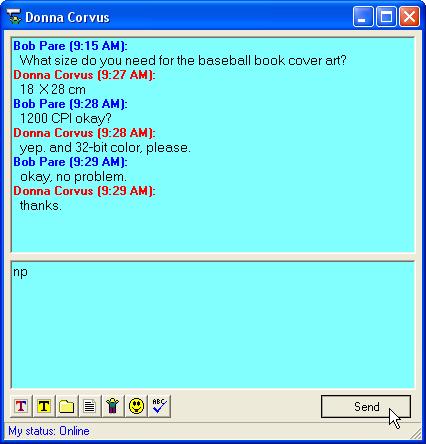
Instant messaging was created in 1996 by Mirabalis. An Israeli startup company, calling their client ICQ Say it Out Loud was the first company to offer instant messaging for free. People all over the world were able to communicate with one another in an instant without worrying about long distance phone call costs or waiting for emails. Eventually, American Online’s AOL Instant Messenger (AIM) bought out Mirabalis and is now the most used instant messenger system.


Instant messaging is not only a tool for recreational use, but when used properly in the office, it can raise the efficiency level of workers. They are able to “instantly” contact coworkers in the office for quick questions or file transfers that if left to email, may not be answered within a few minutes or hours depending on how often an individual checks their email. According to an interviewee of Ms. Robo from Salary.com, they use instant messaging for immediate contact with their cliental that could be states away. Also, instant messaging gives the luxury of being able to take time to think about questions being asked, unlike on the telephone when put on the spot.


Unfortunately, people do abuse the service, and for that reason alone, businesses are slow in allowing their employees instant messaging usage. Individuals tend to start instant messaging their friends outside of the work place, making them unproductive. Also, hard drives and large company computer systems are more susceptible to being hacked through the instant messaging software.


http://www.boston.com/jobs/nehra/112805.shtml

http://www.salary.com/advice/layouthtmls/advl_display_nocat_Ser79_Par168.html

Sunday, April 5, 2009

Jargon in professional writing

Jargon is widely used in professional writing. Definition of a jargon is language that is used by a group, profession, or culture, especially when the words and phrases are not understood or used by other people. On many occasions people think of jargon as a style that is unintelligible. Jargon is commonly used by groups that have similar interests, professions, and trades. Jargon can be used in a form of writing or communication. Which ever way it is used there will be a population of people who will either understand it or not.

Positive aspects of using jargon in writing:

Using jargon in a professional writing makes it easier for a person read through the information if he/she already has the knowledge of the topic. This makes it easier to communicate with their fellow workers and friends. People use jargon to impress other people in situations like job interviews, class discussions, and meetings. For people with the same profession it is a universal language that is used to communicate with each other.

Negative aspects of using jargon:

Jargon can make a person feel very confused on what he/she is reading if they don’t have the knowledge of the topic. It is unprofessional to write a letter using jargon when you are in a business environment. Jargon can make a person come out as lazy and unproductive in a working environment.


http://commguide.asu.edu/writing/jargon
http://www.uncp.edu/home/canada/work/allam/1914-/language/jargon.htm

Friday, April 3, 2009

Professional Writing within NCAA Athletics Administration (Steven Binninger)


There are requirements that must be met for an institution to qualify for athletics competition. The NCAA, the governing body of intercollegiate athletics, requires institutions to audit their operations from compliance, gender equality, financial reports, all the way to facilities depreciation/ appreciation. There are multiple components and reports that are required for membership in the NCAA.

These components are:

The Equity in Athletics Disclosure Act (EADA):

The EADA is a required report that must be completed by intercollegiate athletics administration and/or any institution obtaining federal funds through Title IX. This report comprises information regarding the institutions diversity within its staffing, Expenses/ Salary Benefits, Revenues: Institutional Support, Concessions, Signage, Sponsorships, Expenses: Contract Services, expansion of facilities and/or staffing, Athletics Participation, Athletically related Student Aid, Head Men’s and Woman’s Coaches salaries, and overall expenses not allocated by gender. This report takes weeks to compose and its data takes months to formulate by the various departments within the athletics staff. This report is signed off by the President of the institution as well as the athletic director.

Academic Progress Rate (APR)/ Graduation Success Rate (GSR):

APR is an evaluation of academic progress for each sporting team. Each team is rewarded points for various GPA’s, transfers, years on the team, all tasks related to academic performance. GSR is a figure that displays the success of student athletes upon completion of their bachelor’s degree. These figures affect scholarship availability for all teams. Poor results in the APR and GSR result in a loss of scholarship money.
These are two major reports of NCAA athletics administration that are mandatory for all institutions.

National Collegiate Athletic Association. “Academic Reform.” 2 Apr. 2009.
[http://www.ncaa.org/wps/ncaa?ContentID=276].

“NCAA, EADA figures often Differ.” USA Today. (11 July 2007). 2 April 2009.
.

Monday, March 30, 2009

Random Tips for Specific Results in a Job Interview

Getting a job is beyond just having great credentials and work experience. The interview itself can make or break the opinion your possible future employer may have of you. I have included a few quick tips that will have you on your way to attaining that job you're going for.

1. Relax. The pre-interview stress can sometimes be too bear and have your thoughts and words all out of wack. Try to show up to the location of the interview at least a few minutes early to give yourself a moment to breathe. If you are not rushing in at the last minute, you will be less likely to be in a panic.

2. Prepare. Be ready with a resume in hand. They are not going to want to waste their time with someone who has not invested the time before the interview themselves.

3. Research. Don't just know the title of the position you are going for, but know the company and what they stands for. Be familiar with goals, objectives, and history of the company. This will let them know you are interested in what they do and how they do it.

4. Dress. No matter what the position you are applying for, dress professional. This will show the interviewer you are to be taken seriously. First impressions have lasting affects.

There are so many more things that need to be considered before going into job interview. If time permits to research and do more preparation, go for it! But, if you are in last minute crunch, follow these few tips and you will be on your way to a new job!

Random Humor: You might be a redneck if the interviewer asks "Did you know we're a fortune 500 company?" And you answer "what track do ya'll sponsor that race at? I ain't never been to that one!"

Find more humor and fun at humorasylum.com

Writing in Accounting (Stephen Wickens)

When dealing with accounting people think it is all about the numbers, numbers, numbers. When you are an accountant you must write a number of different business related reports. You must be very inclined inside of the business as you must understand what is going on internally and externally in order to properly report on what is happening with the company. Accountants are responsible for writing internal memos to supervisors, colleagues, to request or provide information, various letters to clients, agencies and other readers, and the also provide technical reports, memos and financial statements regarding the businesses information.

When writing an email or memo, accountants usually use this type of communication inside of the business. They use these to contact other employees to retrieve information about various accounts or problems within the business. Emails and memos can be any length, from one paragraph, too many. It is very important to be clear and concise when writing an email or memo.

Accountants also must write letters to people outside of the company in order to retrieve information or notify others of an important situation that has happened within the business. These letters should contain correct, complete information with a specific reader in mind. There should never be any doubt with the information presented within these letters. These letter are always professional in appearance.

The biggest thing that accountants must write about are the reports in dealing with the financial information inside of the company. This is the most important thing that an accountant is responsible for. These reports are usually presented within the financial statements, which are, the balance sheet, the income statement and the statement of cash flow. These reports are used to analyze the company in order to see if any changes must be made within. Reports are sent along with these financial statements to provide the analysis about the balance sheet, income statement and statement of cash flows. The accountant must be very precise as the entire business is run off of the information found on these financial statements.

If you want to learn more about accounting and the writing inside of accounting, you can take a tutorial through this website:
http://www.biz.uiowa.edu/acct/writing/
May & May. 2003 "Effective Writing: Handbook for Accountants" March 30, 2009