Monday, April 6, 2009

Effective Emails Made Easy By Chelsie Kistner

Well, we don't use pigeons anymore, neither Horse n' Buggy, to send messages to other people in other regions. For that matter, we hardly use paper at all, even when you may be within the same office complex! Today, in the 21st Century, emails are the number one way of communication in the workplace. They include everything from the change of time for a meeting, down to the details of multi-million dollar construction projects. Regardless of the purpose, its crucial to deliver your message in a professional, effective way. Here are a few things I keep in mind, when sitting down to compose an email:

1. Avoid acronyms and abbreviations. Not everyone may understand what they stand for, losing some of the meaning behind your writing.

2. Get to the point, but in a gentle way. Be considerate of others time and feelings. Don't be rude or lengthy.

3.  Show some appreciation. Use words like please and thank you. From what I heard growing up, these words can take you a long way in life.

4. Check your subject line. Make sure it is the topic you are writing on. The reader should have an idea of what the email is in reference to without opening it. Avoid "Hi" or other general, uninformative subjects titles.

5. Plz prufread!...Our fingers can get ahead of us in typing and cause errors we may not have noticed. You should use spell check and make sure you are saying what you wanted to say.


Writing Advertising Copy (Sally Vale)

Writing Advertising Copy
Catching, and keeping, a reader’s attention, to the point that they are willing and ready to buy or use your product or services, can be tricky. Here I will go over some do’s and don’ts of writing ad copy.
• DO use words for embellishment: the power of dialect should never go underestimated. Words provoke a response in people, so be sure to use words that pop out at a reader.
• DO write a headline that will attract your audience to read the rest of your advertisment.
• DON’T preach to the audience. Write to them as if it’s one-on-one.
• DO use a present or active voice. Past or passive tense should only be used intentionally, and for a specific purpose.
• DON’T use clichés. Chances are, your audience is so used to the cliché that it will leave their mind as soon as they read it.
With those quick points in mind, go out and write your ad copy.
Here is a quick video to help you out, and some sites that have great information on writing effective advertisement copies:


"www.AllBusiness.com". AllBusiness. April 6 2009 .

Writing in information technology by Robert Hunley

Writing in Information technology is like any other writing. You plan, research, write, review and revise your topic.

When planning you must recognize your audience and their amount of knowledge, especially in IT Reports. One must make sure to define any technical terminology that their reader may not understand to fully build their picture.

When doing research, one should find a solid central starting point from which they can build from to complete their topic and easily work around.

While writing the paper one should make sure not to leave out any information vital to the understanding of their paper.

Depending on your audience have many people review your paper so you can see different people’s views on your paper.

Revise to correct errors and improve your paper

Writing Memo Tips (Stephen Wickens)

When beginning to write a memo, there are three main idea’s you must stay focused on in order for the memo to read and work easily.

Audience and Purpose:

  • It is very important to understand who you are writing to and what the main purpose of the memo is going to be.
  • Bring attention to the problem, or provide a solution to the problem at hand
  • Most effective when they connect the purpose of the writer with the interests and needs of the reader
  • Only send the memo to who it concerns, most effective when sent to a small or moderate amount of people to communicate company objectives


Parts of a Memo:

  • Heading Segment
    - Make sure you address the reader by his or her full name and job description. In the subject line be very specific and concise.
  • Opening Segment
    - The opening segment is very important, it includes the purpose of the memo, the context, the problem, and the specific assignment or tasks. Give the reader a brief overview of what the memo will be about. Remember! You want to be brief and to the point.
  • Discussion Segment
    - The discussion portion is the longest part of the memo and this is where you include the details of the subject at hand. You want to begin this part with you most important information, and you want to use strong points and evidence to persuade the reader to use your recommended actions.
  • Closing Segment
    - Once the reader has gone through all of your information you’ve presented, you want to end the memo with an ending that states what action you want them to take.

Format:

  • Should follow the general guidelines of business writing
  • 1-2 pages in length, single spaced and left justified
  • No indentations for paragraphs, skip a line in between sentences
  • Should be concise and easy to read
  • Use headings and lists to help readers locate certain information

If you would like to view an example of a memo, click on the link below:
http://owl.english.purdue.edu/owl/resource/590/04/

The Role of Instant Messaging in Professional Writing (Katie Donnellan)

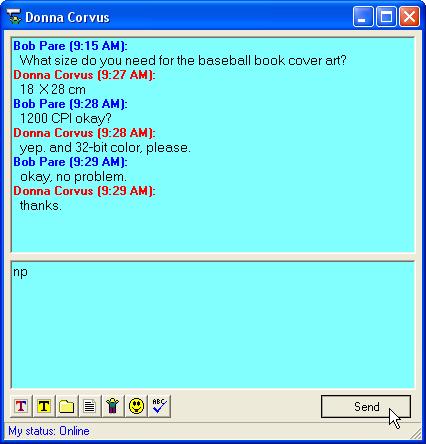
Instant messaging was created in 1996 by Mirabalis. An Israeli startup company, calling their client ICQ Say it Out Loud was the first company to offer instant messaging for free. People all over the world were able to communicate with one another in an instant without worrying about long distance phone call costs or waiting for emails. Eventually, American Online’s AOL Instant Messenger (AIM) bought out Mirabalis and is now the most used instant messenger system.


Instant messaging is not only a tool for recreational use, but when used properly in the office, it can raise the efficiency level of workers. They are able to “instantly” contact coworkers in the office for quick questions or file transfers that if left to email, may not be answered within a few minutes or hours depending on how often an individual checks their email. According to an interviewee of Ms. Robo from Salary.com, they use instant messaging for immediate contact with their cliental that could be states away. Also, instant messaging gives the luxury of being able to take time to think about questions being asked, unlike on the telephone when put on the spot.


Unfortunately, people do abuse the service, and for that reason alone, businesses are slow in allowing their employees instant messaging usage. Individuals tend to start instant messaging their friends outside of the work place, making them unproductive. Also, hard drives and large company computer systems are more susceptible to being hacked through the instant messaging software.


http://www.boston.com/jobs/nehra/112805.shtml

http://www.salary.com/advice/layouthtmls/advl_display_nocat_Ser79_Par168.html

Sunday, April 5, 2009

Jargon in professional writing

Jargon is widely used in professional writing. Definition of a jargon is language that is used by a group, profession, or culture, especially when the words and phrases are not understood or used by other people. On many occasions people think of jargon as a style that is unintelligible. Jargon is commonly used by groups that have similar interests, professions, and trades. Jargon can be used in a form of writing or communication. Which ever way it is used there will be a population of people who will either understand it or not.

Positive aspects of using jargon in writing:

Using jargon in a professional writing makes it easier for a person read through the information if he/she already has the knowledge of the topic. This makes it easier to communicate with their fellow workers and friends. People use jargon to impress other people in situations like job interviews, class discussions, and meetings. For people with the same profession it is a universal language that is used to communicate with each other.

Negative aspects of using jargon:

Jargon can make a person feel very confused on what he/she is reading if they don’t have the knowledge of the topic. It is unprofessional to write a letter using jargon when you are in a business environment. Jargon can make a person come out as lazy and unproductive in a working environment.


http://commguide.asu.edu/writing/jargon
http://www.uncp.edu/home/canada/work/allam/1914-/language/jargon.htm

Friday, April 3, 2009

Professional Writing within NCAA Athletics Administration (Steven Binninger)


There are requirements that must be met for an institution to qualify for athletics competition. The NCAA, the governing body of intercollegiate athletics, requires institutions to audit their operations from compliance, gender equality, financial reports, all the way to facilities depreciation/ appreciation. There are multiple components and reports that are required for membership in the NCAA.

These components are:

The Equity in Athletics Disclosure Act (EADA):

The EADA is a required report that must be completed by intercollegiate athletics administration and/or any institution obtaining federal funds through Title IX. This report comprises information regarding the institutions diversity within its staffing, Expenses/ Salary Benefits, Revenues: Institutional Support, Concessions, Signage, Sponsorships, Expenses: Contract Services, expansion of facilities and/or staffing, Athletics Participation, Athletically related Student Aid, Head Men’s and Woman’s Coaches salaries, and overall expenses not allocated by gender. This report takes weeks to compose and its data takes months to formulate by the various departments within the athletics staff. This report is signed off by the President of the institution as well as the athletic director.

Academic Progress Rate (APR)/ Graduation Success Rate (GSR):

APR is an evaluation of academic progress for each sporting team. Each team is rewarded points for various GPA’s, transfers, years on the team, all tasks related to academic performance. GSR is a figure that displays the success of student athletes upon completion of their bachelor’s degree. These figures affect scholarship availability for all teams. Poor results in the APR and GSR result in a loss of scholarship money.
These are two major reports of NCAA athletics administration that are mandatory for all institutions.

National Collegiate Athletic Association. “Academic Reform.” 2 Apr. 2009.
[http://www.ncaa.org/wps/ncaa?ContentID=276].

“NCAA, EADA figures often Differ.” USA Today. (11 July 2007). 2 April 2009.
.

Monday, March 30, 2009

Random Tips for Specific Results in a Job Interview

Getting a job is beyond just having great credentials and work experience. The interview itself can make or break the opinion your possible future employer may have of you. I have included a few quick tips that will have you on your way to attaining that job you're going for.

1. Relax. The pre-interview stress can sometimes be too bear and have your thoughts and words all out of wack. Try to show up to the location of the interview at least a few minutes early to give yourself a moment to breathe. If you are not rushing in at the last minute, you will be less likely to be in a panic.

2. Prepare. Be ready with a resume in hand. They are not going to want to waste their time with someone who has not invested the time before the interview themselves.

3. Research. Don't just know the title of the position you are going for, but know the company and what they stands for. Be familiar with goals, objectives, and history of the company. This will let them know you are interested in what they do and how they do it.

4. Dress. No matter what the position you are applying for, dress professional. This will show the interviewer you are to be taken seriously. First impressions have lasting affects.

There are so many more things that need to be considered before going into job interview. If time permits to research and do more preparation, go for it! But, if you are in last minute crunch, follow these few tips and you will be on your way to a new job!

Random Humor: You might be a redneck if the interviewer asks "Did you know we're a fortune 500 company?" And you answer "what track do ya'll sponsor that race at? I ain't never been to that one!"

Find more humor and fun at humorasylum.com

Writing in Accounting (Stephen Wickens)

When dealing with accounting people think it is all about the numbers, numbers, numbers. When you are an accountant you must write a number of different business related reports. You must be very inclined inside of the business as you must understand what is going on internally and externally in order to properly report on what is happening with the company. Accountants are responsible for writing internal memos to supervisors, colleagues, to request or provide information, various letters to clients, agencies and other readers, and the also provide technical reports, memos and financial statements regarding the businesses information.

When writing an email or memo, accountants usually use this type of communication inside of the business. They use these to contact other employees to retrieve information about various accounts or problems within the business. Emails and memos can be any length, from one paragraph, too many. It is very important to be clear and concise when writing an email or memo.

Accountants also must write letters to people outside of the company in order to retrieve information or notify others of an important situation that has happened within the business. These letters should contain correct, complete information with a specific reader in mind. There should never be any doubt with the information presented within these letters. These letter are always professional in appearance.

The biggest thing that accountants must write about are the reports in dealing with the financial information inside of the company. This is the most important thing that an accountant is responsible for. These reports are usually presented within the financial statements, which are, the balance sheet, the income statement and the statement of cash flow. These reports are used to analyze the company in order to see if any changes must be made within. Reports are sent along with these financial statements to provide the analysis about the balance sheet, income statement and statement of cash flows. The accountant must be very precise as the entire business is run off of the information found on these financial statements.

If you want to learn more about accounting and the writing inside of accounting, you can take a tutorial through this website:
http://www.biz.uiowa.edu/acct/writing/
May & May. 2003 "Effective Writing: Handbook for Accountants" March 30, 2009

7 Tips for writing user manuals by Robert Hunley

User Manuals, everyone hates them but sadly some of us need them. Here are 7 useful tips for writing a user manual.

1) Anyone might be reading your user manual. Keep it simple enough for any average joe to follow.

2) Proper organization. For some user manuals step by step organization is best and for others an index and small chapters is best. You decide what is best for your manual.

3) Use footnotes to explain any vocabulary that might not be common knowledge.

4) Use pictures and or diagrams when needed, keep the images simple, easy to follow and easy to read to prevent confusion.

5) Use easy to read fonts and colors.

6) Make sure not to leave out any information such as codes, keys, and warning.

7) Have others read the user manual and give constructive criticism.


These simple tips will help you write a better user manual for anyone to use.